Your guide to a hearing and what to expect
Find out how hearings work and what will happen if you are asked to attend. This section explains who will be there, what you will be asked to do and the support available if you are a vulnerable witness or require any reasonable adjustments.

Contents
- The hearing
- When do I attend a hearing?
- What will I be asked to do at a hearing?
- Who is in the hearing room?
- Room layout
- Hearing format
- How will the hearing take place?
- What happens at a hearing - a witness perspective?
- What to expect on the day
- Hearing availability
- How many days will I be needed for?
- What if I become unavailable?
The hearing
When do I attend a hearing?
If you are called as a witness in an HCPTS hearing, you will be given advance notice of the date, format, and what is expected from you. The process is slightly different depending on whether you are a witness for the HCPC or for the registrant, but in both cases you will be kept informed and given clear instructions about when and how to attend.
Once an allegation is ready to go to a substantive hearing, the HCPC and any instructed solicitors refer the case to the Tribunal Service. The Scheduling team then arranges the hearing, taking into account the availability of the registrant, witnesses, and others involved.
|
Witnesses for the HCPC If you are a witness for the HCPC, the Scheduling team will contact you to ask for any dates you cannot attend. After this, you will be sent a Notice of Hearing with details of the hearing format, location, date and time. Closer to the hearing, a Hearings Officer will get in touch with you to provide further details and instructions about your attendance.
|
Witnesses for the registrant If you are a witness for the registrant, the HCPTS will ask the registrant to provide dates to avoid for themselves, their representative, and any witnesses they want to call. Once the hearing date is confirmed, the registrant or their representative will let you know the format of the hearing, the date, and the day(s) when you are likely to give evidence. |
What will I be asked to do at a hearing?
Giving evidence
If you are a witness for the HCPC, you may be asked to provide a written witness statement and then attend a hearing. If you are a witness for the registrant, they may also ask you to write a statement and attend the hearing.
When giving evidence, you may be asked questions by both sides, and panel members may also ask you questions. This is called cross-examination and is a normal part of the process. Some questions may feel challenging or uncomfortable, but this is because the panel has a duty to fully test the evidence.
> See our full guidance on giving evidence here
Who is in the hearing room?
The Panel
The three members of the Panel are independent from the HCPTS and are solely responsible for making the decisions.
| Panel Chair: | Leads the hearing. |
| Lay Panel Member: | Is not a part of any profession which the HCPC regulates. |
| Registrant Panel Member: |
Is registered with the HCPC in the same profession as the registrant. |
Other parties
| Legal Assessor: | A lawyer who gives advice on matters of law and procedure. They are independent from the panel but may assist in drafting its decision. |
| Registrant: | The person about whom a fitness to practise concern has been raised. |
| Presenting Officer: |
A lawyer who presents the case on behalf of the HCPC. |
| Hearings Officer: | A HCPTS staff member who facilitates the hearing and supports all parties. |
| Transcriber: | A person who records the hearing so that a verbatim transcript can be produced if required. |
Members of the public
Hearings are usually held in public. This means that members of the public (including the press) are able to attend. Information heard in public may result in reports in the media. Sometimes all or part of a hearing is held in private due to the personal and confidential information that may need to be shared with the panel. The public are not allowed to be present when proceedings are held in private.
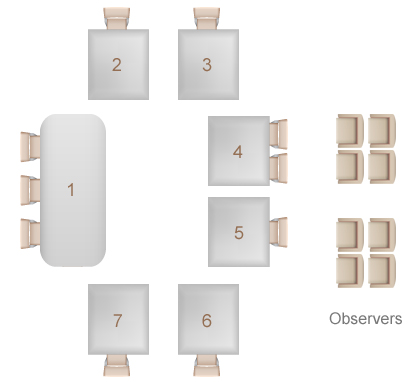
Room layout
|
|
1. Panel The three members of the Panel are independent of the HCPTS and are solely responsible for hearing and determining the allegations. |
Hearing format
How will the hearing take place?
HCPTS hearings can take place in three different formats: virtual, in-person, or hybrid.
Virtual hearings
Most hearings are scheduled virtually unless the HCPC, the registrant, or the panel request a different format. Virtual hearings are held on Microsoft Teams. To join, you will need a device with a working camera and microphone, as well as a stable internet connection. See our factsheet for more information on attending a virtual hearing.
Before the hearing, the Hearings Officer will send you joining instructions and can arrange a test call if you wish. They will also let you know the time you should join and keep you updated throughout the hearing.
In-person hearings
Some hearings are held in person. These usually take place at our Tribunal Centre in London, although we also use venues in Scotland, Wales, and Northern Ireland depending on where the registrant lives. If the registrant lives in England or overseas, the hearing is normally held in London unless there is a strong reason to hold it elsewhere.
The majority of in-person hearings are held at:
Health and Care Professions Tribunal Service (HCPTS)Park House, 184–186 Kennington Park Road
|
Hybrid hearings
A hybrid hearing is a mix of both formats, with some people attending in person while others join virtually. This can be arranged to meet the needs of those involved. For example, a registrant may wish to cross-examine witnesses face to face, while a witness may be unable to travel and instead give evidence remotely.
Our hearing rooms are equipped with video-conferencing technology. If you attend virtually, the Hearings Officer will send you a Microsoft Teams invite and make sure you receive the relevant documents in advance.
What happens at a hearing – a witness perspective
At a hearing, the HCPC presenting officer explains the background to the allegation and may call witnesses to give evidence in support of the case. Witnesses give their evidence one at a time. The first stage is called examination in chief, where you tell the panel what you know about the case.
After this, the registrant or their representative may cross-examine you, asking questions about your evidence. The HCPC presenting officer may then ask further questions in a process called re-examination.
The registrant will also have the chance to give evidence and call their own witnesses. These witnesses may be cross-examined by the HCPC presenting officer and re-examined as well. Throughout the hearing, the panel may ask questions of both the registrant and any witnesses called by either side.
When all the evidence has been heard, the panel will retire to make its decision. They use the civil standard of proof, also known as the “balance of probabilities.” This means a fact is considered proved if it is more likely than not to have happened.
If the panel decides that none of the alleged facts are proved, the hearing ends at that point. If some or all of the facts are proved, the panel will then consider the ground of the allegation before making a final decision.
> For more information about what happens at a hearing, please see our Attending a hearing guidance
What to expect on the day
| Can I claim travel and expenses? | If you are required to travel to a hearing, reasonable expenses such as travel and accommodation (if needed) can be reimbursed. You will be given details on how to claim in advance. |
| What support is available on the day of the hearing? | A Hearings Officer will be your main point of contact on the day. They will explain the process, answer questions, and make sure you are supported throughout. |
| What should I expect when giving evidence? | When it is time for you to give evidence, you will be called into the hearing room or joined to the virtual hearing. You will be asked questions first by the side that called you as a witness, and then by the other side. The panel may also ask you some questions to clarify points. See more guidance on giving evidence here. |
| What happens after I give evidence? | Once your evidence is complete, you may be released from the hearing. Sometimes witnesses are asked to remain available in case they need to be recalled. See more information on what happens after a hearing here. |
Hearing availability
How many days will I be needed for?
It is not always possible to predict exactly when you will be called to give evidence or how long you will be needed. You may need to remain flexible during the hearing day or days.
If you have any concerns or restrictions around your availability, please discuss these with the Tribunal Service team before the hearing. They can provide guidance and help accommodate your needs where possible.
What if I become unavailable?
Once you have provided dates you cannot attend, please refrain from changing them until the hearing date is confirmed. You should avoid making other commitments on the day(s) you are scheduled to give evidence. If needed, the Tribunal Service has the option to formally request attendance at a hearing through a witness summons.
We understand that attending a hearing takes time, but if a witness cannot attend, it may delay the hearing for several months. If something comes up that affects your ability to attend, please contact the Tribunal Service team as soon as possible so they can advise on the next steps.